"For thou art an holy people unto the LORD thy God, and the LORD hath chosen thee to be a peculiar people unto himself, above all the nations that are upon the earth." ~ Deuteronomy14:2

Friday, February 25, 2011

Raising The Standard: Contentment Is Realizing That I Am Indestructible Until My Work Is Done

"But I trusted in thee, O Lord: I said, Thou art my God. My times are in thy hand..." ~ Psalm 31:14-15
From Pages Of Scripture:
Every major accomplishment for God will stir up two types of enemies: those on the outside and those on the inside. Outside enemies mock, criticize, and hinder. They are easier to repel. Those on the inside are like parasites that sap the strength and courage of the workers. Both types of enemies rose up to stop the work of a great man of God. His inward character was the crucial determining factor in the final outcome. By every human standard he should have quit and gone back to the comforts and prestige of his former occupation. But, his awareness of God's hand upon his life gave him the sense of indestructibility that he needed until his work was done. Who was he? Nehemiah.
How Is The Contentment Of Indestructibility Illustrated In Scripture?
In 445 B.C. captains and soldiers, mounted on well trained horses, left the splendor of the capital city of Persia and headed west. In this official delegation was a high ranking adviser of the most powerful ruler in the world. The adviser was on a mission that would go down in history as the most important event of his day. He knew that the task that lay before him was urgent, but he did not know the danger that he was to encounter in attempting to carry it out. When the delegation passed over the Jordan River and entered into a provincial city, a meeting was held with several governors. The adviser gave each one an official letter. The governors were startled by the contents. They were surprised to learn that such a high ranking official would want to help the despised remnant in the city of Jerusalem. Two evil men learned about the adviser's plans and purposed to do all they could to stop them. As soon ad the delegation left town, these evil men held an emergency meeting and laid out their strategy. Meanwhile, the official and his party traveled on to Jerusalem. Several days later, a special meeting was held in Jerusalem with all the rulers, priests, and nobles. The king's adviser reminded his listeners that the rubble and ashes of the once towering city walls were a stark testimony to the judgment of former days. Then he told them about the king's desire to have the walls rebuilt. The people were excited to begin the task. No sooner had they begun, however, than the opposition unleashed its continuous attacks. They began with mocking and then made false accusations and requests for meaningless conferences. When these failed, they prepared to come upon the builders with armed force, but the builders anticipated their move and doubled their protection. One evening the king's adviser was informed that a man by the name of Shemaiah had a special revelation to give him. The adviser went to Shemaiah's house and listened to the message. "God has warned me that there is a special plot against your life. Your enemies will come in by night and will slay you. Come, let us flee to the temple and lock ourselves inside. That is the only way to save your life." The adviser studied the fearful eyes of the "prophet," and without hesitation responded, "Who am I, that I should flee to the temple to save my life. No, I will not do it." The prophet had been hired by those two wicked men to trick the king's adviser into violating God's Law by going into the temple. What those wicked men did not realize was that a death threat would have little effect. The adviser was accustomed to death threats. One of his duties had been to drink of the king's cup in order to test it for poison. In addition to this, he knew that his present work was ordained by God, and that meant that he was indestructible until his work was done. Under Nehemiah's leadership, the walls were rebuilt in the remarkably short time of fifty two days! [From Nehemiah 1-6]
What Did It Cost Nehemiah To Leave Persia?
The historian Herodotus, Nehemiah's contemporary, wrote that the office of cupbearer was "one of no trifling honor." Among Nehemiah's responsibilities was the job of protecting the king from assassination. Since Artaxerxes' own father had been killed by the head of the palace guard, Nehemiah must have proven himself to be an of outstanding character and trustworthiness. Nehemiah enjoyed the friendship of the world's most powerful ruler and had access to the riches and pleasures of the fabulously wealthy empire. But like Moses, who refused to identify with the powerful and wealthy Egyptians, "Choosing rather to suffer affliction with the people of God, than to enjoy the pleasures of sin for a season; Esteeming the reproach of Christ greater riches than the treasures in Egypt: for he had respect unto the recompense of the reward" (Hebrews 11:25-26), so Nehemiah chose to leave Persia and suffer with his people in Jerusalem. In terms of Nehemiah's personal safety, comfort, and position, the cost was great.
Why Was Nehemiah Able To Lead So Effectively?
Nehemiah accomplished in fifty two days what good men before him had not been able to accomplish in almost a century. One aspect of Nehemiah's character undergirded his many abilities. Nehemiah never asked others to make a sacrifice that he himself was not willing to make. For example, he asked his countrymen to move into and help rebuild a ruined, unwalled city. But he set the example by leaving the capital of the empire, the palace itself. He asked men to participate in hard labor and set the example by not even removing his own work clothes at night. (See Nehemiah 4:23; 5:16) He called for courage and then modeled courage by refusing to cower at an alleged assassination attempt. Nehemiah earned the respect and allegiance of all the people.
What Kept Nehemiah From Becoming Disabled By Fear?
Most men fear what they can see or hear and react accordingly. Nehemiah saw rubble, back breaking labor, and powerful enemies. He heard ridicule, threats, and slander. Most men would have given up. But Nehemiah saw and heard what most men do not perceive --- the God of Israel, Whom he feared more than men or things. His initial prayer for the project began, "... I beseech thee, O Lord God of heaven, the great and terrible God..." (Nehemiah 1:5). Later, he admonished the greedy nobles and rulers of Jerusalem "... to walk in fear of our God..." (Nehemiah 5:9). He refused to accept certain rights "... because of the fear of God" (Nehemiah 5:15). He appointed his brother, Hananiah, as his successor because "... he was a faithful man, and feared God above many" (Nehemiah 7:2). The fear of God in Nehemiah's heart gave him contentment in knowing that he was indestructible until his God-given task was completed.
Illustrated In The World Of Nature:
The porcupine is a large, prickly rodent, which weighs up to 20 pounds and is approximately 30 inches long. It spends half of its solitary life in trees. During the winter it does not hibernate, but chooses rather to remain in the tops of trees for several weeks, eating all the bark it can reach. Although fully protected by its quills, the porcupine will not provoke an attack. It will rather retreat to safety. Indians and early settlers valued the porcupine for saving the lives of many lost forest travelers since even a weak and hungry man could catch it for a meal.
How Is The Contentment Of Indestructibility Illustrated In The World Of Nature?
Moments after his birth, an amazing little animal instinctively stood up, arched his back, and energetically swung his well-equipped tail. Minutes later, thirty-three thousand razor like quills hardened and became a formidable defense against any potential attacker. Under the careful guidance of his parents, the young arrival to the forest developed skill in using his God-given arsenal. One day as he was slowly moving through the forest, the young explorer started up a large pine tree and found an exposed layer of sugar-covered bark. He had no sooner begun enjoying the sticky sweetness when he heard a thunderous roar behind him. Suddenly, a short tempered black bear stormed through the underbrush, enraged by the invasion of its territory. As the angry bear approached, the feasting porcupine clutched the tree with his long, curved claws. The bear stood up to his full height and, with one swipe of its powerful paw, sent the porcupine catapulting through the air into a nearby thicket. The loose skin of the porcupine absorbed much of the shock; thus, he quickly recovered. Immediately he went into a defensive posture and waited for the next attack. But another attack would not be coming. The bear had suddenly lost all interest in the porcupine, the pine tree, and its territory. Sitting on its haunches, the injured bear frantically tried to remove a dozen painful quills from the soft pad of its paw. Soon the distracted bear limped away into the woods. The porcupine continued his journey through the forest. As he climbed up on a fallen log, he heard the rustle of leaves and the snarl of a hungry coyote. The porcupine immediately saw the coyote's prey --- a helpless fawn paralyzed with fear. In no mood to be disturbed by an intruder, the coyote lunged at the porcupine. With a swift flick of his tail, the well-armed defender sent scores of barbed quills out with both front paws. It was a futile attempt. The fawn and the porcupine quietly watched as the howling coyote retreated into the forest. The fawn's life was preserved because of the contentment of indestructibility which had given special courage to her protector. The Characteristics Of The Porcupine In Scripture: The protection which gives the porcupine its confidence is an illustration of the security that every Christian can have when surrounded by spiritual enemies. (See Ephesians 6:13-17) Just as the armor of the porcupine is designed primarily for defense, so our armor is designed that we
"... may be able to withstand in the evil day, and having done all, to stand." ~ Ephesians 6:13
The porcupine's only offensive weapon is its sharp quills. Similarly the only weapon which God has provided for the Christian is the sword of the Spirit, which is the Word of God. (See Ephesians 6:17) This sharp weapon, like the quill, continues to do its work once it enters the person. The porcupine has two vulnerable areas: its "glass jaw", and its underside. The Christian also has vulnerable areas which need to have constant protection: his mouth and his heart.
"Keep thy tongue from evil, and thy lips from speaking guile" ~ Psalm 34:13
"Keep thy heart with diligence; for out of it are the issues of life" ~ Proverbs 4:23
The porcupine spends great amounts of time in the tree turning bark into sweet nourishment, just as we are to meditate day and night upon God's Word. Scripture is
"... sweeter also than honey and the honeycomb" ~ Psalm 19:10

Friday, February 18, 2011

Raising The Standard: Contentment Is Valuing God-given Relationships More Than Earthly Possessions

"While we look not at the things which are seen, but at the things which are not seen: for the things which are seen are temporal; but the things which are not seen are eternal." ~ 2 Corinthians 4:18
From The Pages Of Scripture:
The axiom "Familiarity breeds contempt" is all too often true. We tend to take for granted those who are closest to us. Only when loved ones are gone is their importance to our lives recognized. It is then that we wish we could turn back and reclaim lost opportunities to express appreciation and deepen fellowship. Scripture reveals how one wise and perceptive person was able to avoid such regrets in a very important relationship. Who sacrificed a valuable possession for an important relationship, but was severely criticized for doing it by a greedy observer? Mary of Bethany.
How Is The Importance Of God-given Relationships Illustrated In Scripture?
The tension of an impending crisis filled the room as guests ate a meal. A few miles away, jealous rulers plotted the death of the group's leader. During the meal, one of the hosts did something very unexpected. Everyone at the table was amazed. Finally, one of the most respected dinner guests openly condemned the action as useless and out of place. The leader of the group quickly defended the host and tried to reason with the angry guest, whose warped mind failed to grasp the significance of the action. After the meal, the critic slipped away from that group and met with the hostile officials in the nearby city. He asked what they would pay him if he cooperated with their plan. They agreed on a price. As the disgruntled member of the group returned from that secret meeting, he might have congratulated himself for the shrewdness of his plan. He would do his part in the plot, collect the money, and then his leader could miraculously escape as he had done on previous occasions, or he would set up his kingdom as he had promised. Several days later, the conspiracy was carried out. The greedy critic did his part and collected his reward. But events did not turn out as he had planned. His leader was captured and condemned to die. It was then that the horror of what this angry man had just done penetrated his twisted mind. He grabbed the money which he had received and met again with the jealous leaders. He tried to explain that he was wrong and that he wanted to return the money in exchange for the life of his leader. They laughed at him and refused to talk any further about it. He flung the money to the floor and walked out into the darkness. Instead of perceiving a new light in the act which he had so severely criticized just six days earlier, he prepared a noose for his own neck. The action he condemned was the anointing of Jesus with very expensive ointment. The action demonstrated to everyone that the one who did it treasured the fellowship of Christ more than earthly possessions. What he had done demonstrated just the opposite. He traded fellowship with Christ for thirty pieces of silver and caused the name of Judas to be despised forever. She exchanged her treasure for deeper fellowship with Christ and caused the name of Mary of Bethany to be honored forever. [From John 12:1-8 and Matthew 26:3-16; 27:3-5]
Why Would The Lord Want Us To Remember Mary's Gift?
Mary of Bethany reminds us to guard our priorities. It is true that the Lord wants us to minister to those in need. He Himself set the example in compassion for the poor, the sick, the helpless, the widow, and the orphan. But Mary reminds us not to replace worship with works. There are times when it is appropriate to "waste" our abilities and possessions in grateful devotion to our Lord (See Matthew 26:8). Mary also teaches us to look beyond physical needs to man's spiritual needs. Food, clothes, and shelter are important, but a man's soul is more important. Mary recognized that the Lord's life, death, and resurrection was the real purpose of His earthly mission. He came to provide eternal life by dying for out sins. (See 1 Corinthians 15:11-4) This is the message that should accompany our acts of compassion.
What Did Mary's Action Cost Her?
Judas estimated the value of Mary's perfume at three hundred denarii, about a year's wage for a common laborer. (See John 12:5) It was probably imported from India in a sealed alabaster jar to conserve the perfume. Wealthy people broke the seal only for very special guests. Inexpensive olive oil mixed with fragrant spices was more commonly used. In that day the economic situation of an unmarried woman such as Mary was precarious. A woman depended on the financial support and physical protection of either her father or husband. It appears that Mary had neither. It is possible that this perfume was part of her bridal gift, or dowry, for some future husband. In any case, Mary demonstrated that her contentment and security were found in Christ.
Why Was Mary More Spiritually Perspective Than Others?
Spiritual perception is a by-product of faith which "...cometh by hearing, and hearing by the word of God" (Romans 10:17). Mary listened to the words of Christ. (See Luke 10:39) Jesus had said, "Therefore doth my Father love me, because I lay down my life, that I might take it again. No man taketh it from me, but I lay it down for myself. I have power to lay it down, and I have power to take it again..." (John 10:17-18) Mary pondered these teachings and was beginning to understand that Jesus needed to die and rise again to atone for her sin. Jesus had just demonstrated His power over death in the miraculous resurrection of her brother. Mary recognized that He indeed had the power to take His life back from the dead. She understood more fully the meaning of the Lord's statement to Martha, "...I am the resurrection, and the life; he that believeth in me, though he were dead, yet shall he live: And whosoever liveth and believeth in me shall never die..." (John 11:25-26) Mary was the first to understand the significance of Christ's words and, knowing that His death was imminent, anointed His body for burial with the most precious substance she possessed.
Illustrated In The World Of Nature:
The pack rat is a member of the wood rat family of which there are about twenty different species. The young, born in litters of two to six, weigh about one-half ounce. They are usually weaned by the third week and by the third month are ten times their birth weight. Adults are about eighteen inches long, half of that length belonging to its tail. Pack rats are amazingly well adapted to desert conditions. They are swift runners along logs, rocks and rafters and are excellent climbers. In addition to the ground nest, they often build secondary nests in nearby trees.
How Is The Unimportance Of Possessions Illustrated In The World Of Nature?
Balancing himself on his long tail, the pack rat violently lashed out at his mate. The female rat successfully repulsed the attack with sharp claws and a nasty bite. With his left ear severely damaged, the humiliated male darted from his nest to search for more solitary surroundings. Exploring for a more suitable home, the wounded rat discovered a vacant cactus and quickly began to establish his territorial presence. Satisfied with the progress on his new nest, the pack rat anxiously scouted the desert environment. A search for shiny trinkets and sparkling baubles to furnish his dwelling brought him to the broken-down porch of an old abandoned shack. When his twitching nose and whiskers sensed that no danger was present, the curious rat scampered across the rough pine floor. Behind a dusty pile of logs near the crumbling fireplace, a small string caught the pack rat's inquisitive eye. Nosing his way into an old leather pouch, the pack rat uncovered three gold nuggets. Delighted with his newfound treasure, the excited rat scurried back toward his nest, protectively carrying one of the nuggets between his teeth. Suddenly, a glimmer in the desert sand distracted the impulsive pack rat. The midday sun had brilliantly lit up a discarded gum wrapper. Fascinated by the silvery reflection, the pack rat gladly abandoned his gold in exchange for the shiny but worthless paper. His second trip from the shack was similarly sidetracked by the captivating movements of a colorful feather animated by the desert breeze. Once again the foolish pack rat swapped his nugget for a prize of lesser value. For the third time he entered the shack, scooped up the remaining nugget, and ran toward his nest. As he bounded along, his eyes constantly searched the horizon for other things more attractive than the one he was carrying. Suddenly he saw the most interesting object yet, s shiny key chain at the base of a large cactus. The pack rat was so absorbed in making his new exchange that he failed to notice a coyote crouching nearby. With the heavy key chain in his mouth he again started out for his nest. Seconds later he felt himself being thrown into the air. He lost the keys and came down into the jaws of a hungry coyote. His discontent caused him to lose his life in exchange for shiny trinkets.
The Characteristic Of The Pack Rat In Scripture:
The persistent obsession of the pack rat to collect bright, shiny things is an apt illustration of the nature of man.
"Surely every man walketh in a vain shew ... he heapeth up riches, and knoweth not who shall gather them." ~ Psalm 39:6
The pack rat's practice of exchanging one thing for another is exemplary of human conduct. We exchange time for money, and money for food, etc. Paul wisely exchanged temporal things in order to experience more of Christ (See Philippians 3:8). The pack rat's inability to live in harmony and its ultimate resorting to a solitary existence is an accurate commentary on anyone who would seek after wealth.
"He that is greedy of gain troubleth his own house; but he that hateth gifts shall live." ~ Proverbs 15:27
The destructive end of the featured pack rat is also predictive of the person who makes wealth his goal.
"But they that will be rich fall into ... many foolish and hurtful lusts ... For the love of money is the root of all evil: which while some coveted after, they have erred from the faith, and pierced themselves through with many sorrows." ~ 1 Timothy 6:9-10
The pack rat's lack of contentment with possessions illustrates Ecclesiastes 5:10, "He that loveth silver shall not be satisfied with silver; nor he that loveth abundance with increase..."

Thursday, February 17, 2011

Musical Interlude: The Word Is Alive

Raising The Standard: Cautiousness Is Recognizing That The Majority Is Often Wrong

"Enter ye in at the strait gate: for wide is the gate, and broad is the way, that leadeth to destruction, and many there be which go in thereth: Because strait is the gate, and narrow is the way, which leadeth unto life, and few there be that find it." ~ Matthew 7:13-14
From The Pages of Scripture:
The fact that the majority is usually wrong was painfully clear to a courageous leader in the nation of Israel. He boldly spike out for the minority at a crucial time in history of the chosen people. The majority ignored his counsel and rejected his warnings. Too late to escape the judgment of God, they realized that their cautious leader had been correct. Because he had acknowledged wise counsel and carefully examined every warning, God granted him added years. He also received exceptional strength and an unusual vitality that enabled him to conquer a foreign kingdom and establish a lasting heritage for his descendants. Who gave a special inheritance to his descendants by following the Lord with his whole heart and refusing to accept the wrong conclusion of the majority? Caleb
How Is The Fact That The Majority Is Often Wrong Illustrated In Scripture?
Under cover of darkness, a group of scouts quietly scrambled up a mountainside. These men had been hand picked by their leaders. The report that they were to bring back would determine the course of their whole nation. The men found a place of hiding from which they could view the countryside and then waited. Soon the morning light filled the sky and the men looked out over the breathtaking landscape. One of the men silently resolved that this mountain would become the heritage for his children and their children. Meanwhile, the other scouts stared in disbelief at the massive walls of a nearby city and the colossal size of the giants who guarded it. "How could we possibly conquer such a stronghold?" murmured most of the men. But two of the twelve reminded the rest, "Did not God promise to give us this land? Has He not already destroyed great armies and nations who opposed us?" The scouts divided in opinion, returned to their camp. The majority quickly spread their discouraging report. When the two courageous scouts gave their report and challenged the nation to trust God and obey Him, many of the people picked up stones to kill them. Minds were already made up. The people would listen to the majority opinion. The decision not to go in and conquer the land cost the nation forty years of wandering in the wilderness. During all those years, the commitment made by that faithful scout was never forgotten. It gave him strength, vigor, and purpose in life. Ad the age of eighty-five, he again climbed that mountainside; this time with a group of mighty men who shared his vision and his faith. This courageous man and his soldiers conquered the walled cities and the giants who lived in them. He was then given that mountain with all of its special significance. It was on this very mountain that Abraham, Isaac, and Jacob were buried. They had received God's promise of this land, and Caleb, by refusing to agree with a mistaken majority helped to fulfill that promise [from Numbers 14 and Joshua 14]
Why Was The Hill Country Of Heron So Significant To Caleb?
Caleb had first seen Hebron when Moses had sent him and the other spies into the land. The sons of Anak, men of unusual strength and stature, lived there. When the spies saw them, their hearts melted with fear. They felt like grasshoppers next to these giants (see Numbers 13:22, 33). But, Caleb focused his attention on the grapes, pomegranates, figs, and clear mountain springs. Here, at the highest elevation in the entire land, he had a breathtaking view of the inheritance that the Lord had promised to give to His people. It was at Hebron that Abraham built an alter immediately after the promise was given (see Genesis 13:14-18). As a man of faith, this mountain had special significance to Caleb. It reminded him of the faith of his fathers who feared the Lord and were buried there. This was to be his home, and he wanted to demonstrate the power of God to his family by possessing it.
What Was The Secret Of Caleb's Success?
Caleb was successful in conquering the most feared men in the land, the Anakim of Hebron. He was an example to the leaders of the other tribes to do the same. But even though they tried to occupy their territories, many were unable to penetrate the stronger cities. A lengthy list of cities which the Israelites failed to occupy is given in Judges 1:19-36. Caleb's secret is given as follows, "Hebron therefore became the inheritance of Caleb the son of Jephunneh the Kenezite unto this day, because that he wholly followed the Lord God of Israel" (Joshua 14:14). Caleb himself asserted with clear conscience, "... I wholly followed the Lord my God" (Joshua 14:8). Moses also said of Caleb, "... Thou hast wholly followed the Lord my God" (Joshua 14:9). And God Himself, the perfect discern er of hearts, said, "But my servant Caleb, because he had another spirit with him, and hath followed me fully, him will I bring into the land whereinto he went, and his seed shall possess it" (Numbers 14:24).
What Were Caleb's Lasting Contributions?
Caleb gave to his family some of the best land in the country. More importantly, he gave a land free of the wicked Canaanites, who later became such a snare to many of the Israelites. Joshua sadly declared before his death, "Know for a certainty that the Lord your God will no more drive out any of these nations from before you; but they shall be snares and traps unto you, and scourges in your sides, and thorns in you eyes, until ye perish from off this good land which the Lord your God hath given you" (Joshua 23:13). Another contribution was Caleb's being an example to follow. Because Caleb both challenged himself, Othniel, Caleb's nephew, conquered the fortified city of Debir near Hebron. Later, when the Israelites cried to the Lord for help, it was Othniel whom the Lord used to deliver the nation from the Mesopotamians. Othniel became the first Judge after Joshua, and the nation had forty years of peace. (See Judges 3:8-11)
Illustrated In The World Of Nature:
The red squirrel is known by a number of other common names: chickaree, boomer, barking squirrel, pine squirrel, rusty squirrel, red robber, egg-eater, chatterbox, and adjudaumo, an Indian name meaning "tail in the air". The red squirrel lives a solitary life. Seven years old for him, although some red squirrels have lived up to ten years in captivity. Litters of three to eight are born after a brief gestation period of 38 days. The young are born blind, pink, and hairless. They leave the nest for the first time during their seventh week. The red squirrel does not hibernate but remains active even in cold weather.
How Is A Mistaken Majority Illustrated In The World Of Nature?
With a single springlike vault a tiny red blur catapulted out of the fluffy white snow drift. Securing its sharp claws in the rugged pine bark, the vigilant sentry quickly scampered upward to his treetop outpost. From his favorite branch, the furry watchman scanned the forest below. Always prepared to scold an unwelcome intruder, the energetic sentinel often shattered the wilderness with warnings of danger. Far below the majestic pines, a large family of porcupines clumsily plodded through the forest, the red squirrel's tail suddenly stiffened with apprehension. The squirrel had spotted the sleek brown fur of a hungry fisher as it glistened in the winter sun. The ability to digest the razor like quills made porcupine meat a popular delicacy on the fisher's forest menu. As the clever fisher neared the unsuspecting porcupines, it vanished into the snow. The fisher had marked their position and quietly began to tunnel toward the porcupines. In an attempt to warn the other animals, the red squirrel erupted into a frenzy of foot stomping and tail jerking accompanied by a shrill series of vocal alarms. Ignoring the frantic warnings, the porcupines confidently continued their unhurried journey. They could have easily climbed the tree and avoided danger. However, they were confident that no predator would attack their well-protected hides. As the fisher approached its unsuspecting victims, the warnings of the red squirrel intensified. The porcupines paused momentarily and glanced at the noisy chatterbox with an air of indignation. With blinding speed, the fisher lunged from its snow tunnel, viciously tearing into the underbelly of one of the porcupines. The red squirrel watched the fisher as he licked his paws in a moment of satisfied contentment. The blood-stained snow bank provided a sober reminder to other creatures of the fate of one that had chosen to listen to a wrong majority instead of the solitary voice of caution and warning.
The Characteristics Of The Red Squirrel In Scripture:
The red squirrel vividly illustrates alertness to danger in the world of nature. He faithfully fulfills his duties as the "watchman of the woods". Names like boomer, barking squirrel, and chatterbox accurately describe this furry little sentry. The silent dogs mentioned in Isaiah 56:9-11 provide a sharp contrast to the red squirrel:
"All ye beasts of the field, come to devour, yea, all ye beasts in the forest. His watchmen are blind: they are all ignorant, they are all dumb dogs, they cannot bark; sleeping lying down, loving to slumber ... They all look to their own way, every one for his own gain..."
The alertness of the red squirrel and its ability to sound a noisy alarm fulfill the requirements God had established for the watchmen of Jerusalem:
"I have set watchmen upon they walls, O Jerusalem which shall never hold their peace day nor night..." ~ Isaiah 62:6
The need to warn non-Christians is the responsibility of every Christian:
"When I say unto the wicked, O wicked man thou shall surely die; if thou dost not speak to warn the wicked from his way, that wicked man shall die in his iniquity, but his blood will I require at thine hand" ~ Ezekiel 33:8 (See also Ezekiel 3:18)

Saturday, February 5, 2011

Imam Moustafa Zayed and Robert Spencer Debate: Muhammad taught that Muslims must wage war against and subjugate unbelievers (1/28/11)

Full ninety minute video of the Live Debate on 1/28/11:

Spiritual Warfare and Worldviews for Christian Direction

Spiritual Warfare and Worldviews by Paul G. Hiebert
In recent years, there has been a renewed interest in the gospel as power in the lives of people and in spiritual warfare between God and Satan (Anderson 1991, Arnold 1997, Kraft 1992, Moreau 1997, Powilson 1995, Wagner 1991, to name a few). This comes as an important corrective to the earlier emphasis in many Western churches on the gospel as merely truth, and on evil as primarily human weakness. Both truth and power are central themes in the gospel and should be in the lives of God’s people. But much literature on spiritual warfare has been written by Western missionaries who have been forced to question their Western denial of this-worldly spirit realities through encounters with witchcraft, spiritism, and demon possession. Too often they base their studies in experience and look for biblical texts to justify their views. They fail to examine the worldviews they use to interpret both Scripture and experience. These are hard to see because they are what we think with, not what we think about. Christians and churches are in desperate need of showing God’s power in transformed lives and in a Christlike confrontation of evil wherever they find it.
DIFFERENT WORLDVIEWS AND SPIRITUAL WARFARE
Stories of battles between good and evil, and of power encounters between good gods and evil demons are found in all religions. In Hinduism, Rama battles Ravana, in Buddhism Buddha fights Mara, in Islam Allah wars against Shaitan, and in traditional religions tribal gods fight one another for conquest. What are some of the worldviews that shape the current Christian debate regarding the nature of spiritual warfare? {115}
Modern Supernatural/Natural Worldview:
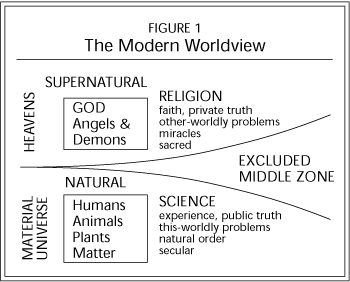
The Western worldview has been shaped since the sixteenth century by the Cartesian dualism that divides the cosmos into two realities: the supernatural world of God, angels and demons, and the natural material world of humans, animals, plants and matter. This has led to two views of spiritual warfare. First, secular materialists deny the reality of the supernatural world and reduce reality to the natural world which can best be studied by science. For them there is no spiritual warfare because there are no gods, angels, or demons. There are only natural wars between humans, communities, and nations. Christians who accept this view demythologize Scripture to make it fit modern secular scientific beliefs. The battle, they claim, is between good and evil in human social systems. The church is called to fight against poverty, injustice, oppression, and other evils which are due to oppressive, exploitative human systems of government, business, and religion. The second view of spiritual warfare emerging out of this Cartesian dualism is that God, angels, and demons are involved in a cosmic battle in the heavens, but the everyday events on earth are best explained and controlled by science and technology (fig. 1). People pray to God for their salvation, but turn to modern medicine for healing and psychology for deliverance from so-called demon possession, because demons exist in the heavens, not on earth. Western missionaries influenced by this dualism affirm the cosmic battle between good and evil, but deny the realities of witchcraft, spirit possession, evil eye, and magic in the cultures where they serve. Consequently they fail to provide biblical answers to the people’s fears of earthly spirits and powers, and fail to deal with the reality of Satan’s work on earth.
Tribal Worldview
For most tribal peoples, ancestors, earthly spirits, witchcraft, and magic are very real. The people see the earth and sky as full of beings (gods, earthly divinities, ancestors, ghosts, evil shades, humans, animals, and nature spirits) that relate, deceive, bully, and battle one another for {116} power and personal gain. These beings are neither totally good nor totally evil. They help those who serve or placate them. They harm those who oppose their wishes or who neglect them or refuse to honor them. Humans must placate them to avoid terrible disasters.
Spiritual warfare in animistic societies is seen as an ongoing battle between different alliances of beings (fig. 2).
For the most part these alliances are based on ethnicity and territory. The battle is not between “good” and “evil,” but between “us” and “others.” The gods, spirits, ancestors, and people of one village or tribe are in constant battle with those of surrounding villages and tribes. When the people of one group defeat those of another, they attribute their success to the power of their gods and spirits. When they are defeated, they blame this on the weakness of their gods and spirits. Territory plays an important role in tribal views of spiritual warfare. Gods, spirits, and ancestors reside in specific places or objects and protect the people who reside on their lands. When a community is defeated, the people are expected to change their allegiance to the stronger god and serve him. Conversions to new gods often follow dramatic “power encounters.”
Some Christians interpret the biblical data on spiritual warfare using the traditional tribal worldview with its emphasis on territory and power encounter.
Satan is viewed as having authority over the earth which he delegates to his demonic hierarchy. The belief in spirits who rule territories and control people implies that these people are hapless victims of the cosmic battles of the gods and that once they are delivered they will be ready to convert to Christ en masse. This sells human sinfulness short. Even if demons are driven out, humans call them back and renew their individual and corporate rebellion against God.
Belief in evil spirits now ruling geographic territories also denies the work of the cross.
Whatever delegated authority Satan had at the time of creation was taken away after the resurrection when Christ declared, “All authority has been given to me in heaven and on earth” (Matt. 28:18 NASB, passim). Satan now has no authority over the earth, only the authority given him by his demonic and human followers. Christians should not identify Satan and his followers with territories that can be exorcized. To do so is to introduce animistic beliefs into the Christian {117} worldview. As Chuck Lowe points out (1998), this view of territorial spirits has little biblical justification.
Indo-European Worldview
A third worldview of spiritual warfare is based on a cosmic dualism (fig. 3). This is found in Zoroastrianism, Manicheism, Hinduism, and other cultures shaped by the Indo-European worldview. In it mighty gods battle for control of the universe: one seeking to establish a kingdom of righteousness and order, and the other an evil empire. Humans are innocent victims caught in the cosmic struggle. The outcome is uncertain for both sides are equally strong. Good and evil here, however, are not defined in absolute moral terms. Good is associated with our people and evil with others. Our gods and people occasionally sin and do evil, but they are “good” because they are on our side. Other gods and people do good, but they are “evil” because they are against us. Central to this worldview is the myth of redemptive violence. Order can be established only when one side defeats the other in spiritual warfare. Violence is necessary to bring about a better society (see discussion in Wink 1992). To win, therefore, is everything. The focus is on the battle. Conflicts and competition are intrinsic to the world and lead to evolution (biology), progress (civilization), development (economics), and prowess (sports).
Morality in the Indo-European battle is based not on the notion of moral rightness but of “fairness” and “equal opportunity.”
To be fair, the conflict must be between those thought to be more or less equal in might. The outcome must be uncertain. It is “unfair” to pit a professional ball team against a team of amateurs. Equal opportunity means that both sides must be able to use the same means to gain victory. If the evil side uses illegal and wicked means, the good side is justified in using them. In movies, the police officer cannot shoot first. When a criminal draws a gun, however, the police officer can shoot the person without a trial. In the end, both the good and the bad sides use violence, deceit, and intimidation to win the battle. In this worldview, chaos is the greatest evil, and power and control are the greatest good. {118}
Indo-European religious beliefs have largely died in the West, but as Walter Wink points out (1992), the Indo-European worldview continues to underlie American entertainment (westerns, detective stories, cowboys and Indians, war stories) and sports (football, hockey).
People pay to see the football battle and go home at the end claiming victory or making excuses for the loss. The story ends when the detective unmasks the villain, the cowboys defeat the Indians, Luke Skywalker and Princess Leia thwart the Evil Empire, and Superman destroys the enemies of humankind. Victory in the Indo-European myth is never final, nor evil fully defeated. Evil rises again to challenge the good, so good must constantly be on guard against future attacks.
Many current Christian interpretations of spiritual warfare are based on an Indo-European worldview that sees it as a cosmic battle between God and his angels and Satan and his demons for the control of people and lands.
The battle is fought in the heavens, but it ranges over sky and earth. The central question is one of power—can God defeat Satan? Because the outcome is in doubt, intense prayer is necessary to enable God and his angels to gain victory over the demonic powers. Humans are victims of this struggle. Even those who turn to Christ are subject to bodily attacks by Satan.
BIBLICAL VIEWS OF SPIRITUAL WARFARE
Warfare is an important metaphor in Scripture and we must take it seriously. Eugene Peterson writes,
"There is a spiritual war in progress, an all-out moral battle. There is evil and cruelty, unhappiness and illness. There is superstition and ignorance, brutality and pain. God is in continuous and energetic battle against all of it. God is for life and against death. God is for love and against hate. God is for hope and against despair. God is for heaven and against hell. There is no neutral ground in the universe. Every square foot of space is contested (1997, 122-23)."
The question is, what is the nature of this battle in biblical terms? One thing is clear: the biblical images of spiritual warfare are radically different from those in the materialistic, tribal, and Indo-European myths (fig. 4). For example, in the Old Testament the surrounding nations saw Israel’s defeats as evidence that their gods were more powerful, but the Old Testament writers are clear—Israel’s defeats are not at the hand of pagan gods, but the judgment of Yahweh for their sins (Judg. 4:1-2; 6:1; {119} 10:7; 1 Sam. 28:17-19; 1 Kings 16:2-3; 2 Kings 17:7-23). Similarly, the battle between God and Satan is not one of power (Job 1:1-12; Judg. 9:23-24). The whole world belongs to God. The gods of the pagans are, in fact, no gods. They are merely human-made images fashioned from wood and stone (Isa. 44:46). Satan is a fallen angel created by God. In the New Testament the focus shifts to a more spiritual view of battle. The Gospels clearly demonstrate the existence of demons or unclean spirits who oppress people. The exorcists of Jesus’ day used techniques to drive spirits away (Keener 1993). Jesus, in contrast, simply drove the demons out on the basis of his own authority (Mark 1:21-27; 9:14-32).
The Nature of the Battle
The Bible is clear that there is a cosmic battle between God and Satan (Eph. 6:12). There is, however, no doubt about its outcome. God is Creator. All the rest is creation, dependent on God’s ongoing creation for its ongoing existence. The very existence of Satan and sinners, and the power they use in their rebellion is given them by God and is testimony to his mercy and love. If the cosmic struggle between God and Satan is not one of power, what is it about? It is the establishment of God’s reign on earth as it is in heaven.
Two parables help us understand the biblical nature of spiritual warfare. The first is the wayward son (Bailey 1998).
The father lavishes his love on his son, but the son rebels and turns against his father. The father is not interested in punishing his son but in winning him back. So the father reaches out in unconditional love. The son wants to provoke the father into hating him, and thereby to justify his rebellion, but the father takes all the evil his son heaps on him and continues to love. When the son repents, he is restored back fully into the family (Luke 15:21-24). Similarly, God loves his rebellious creations and urges them to turn to him for salvation. In this battle for human allegiances, humans are not passive victims. They are active coconspirators with Satan in rebellion against God. {120}
The second parable is the rebellious stewards (Matt. 21:33-44).
They are given legitimate authority by the master over part of the kingdom, but they rebel and persecute those faithful to the master. According to the Indo-European view the king should defeat the rebels by might and destroy them. In the biblical worldview the king first seeks reconciliation. When this fails, he sends his son, but the son is tried in the court of the stewards, found guilty, and put to death. The case is appealed to the king who finds the lower court evil and removes it from power. The central question in Scripture is not power but legitimacy.
Angels and Demons
A biblical view of spiritual warfare calls for a theology of angels and demons. Satan and his hosts are dreadfully real and represent the powers of darkness arrayed in battle against God’s kingdom of light. Walter Kaiser and his colleagues point out that,
"demons are part of the cosmic or spiritual conflict going on behind the outward actions of preaching, teaching, and healing. Demons fit into the New Testament picture of what the reign of God means and the fact that salvation is not simply deliverance from physical sickness or political oppression or poverty, but at root a deliverance from final judgment, from spiritual sin and from the oppression by evil spiritual forces connected to these things (1996, 81)."
Misfortunes and illnesses are the result of sin, but most are not directly caused by demonic sources. They are part of the fallen estate of humans and the judgment of sin. The greatest hindrance to people coming to Christ is not demon activity, real as it is, but human sin and rebellion expressed in fallen cultural and social systems which lead people to worship themselves rather than the Creator (Rom.1:21-25).
Christians are delivered from the power that Satan formerly had over them. Every person who is “in Christ” shares in Christ’s uniqueness and need not be apprehensive or feel paralyzed with fear concerning Satan and evil spirits (1 John 4:4). Satan and his demons have no power over believers other than what God permits.
The Weapons of Warfare
Scripture makes it clear that the weapons of spiritual warfare are different for God and for Satan. Satan blinds the minds of humans to the truth through lies and deception. He tempts them with the pleasures of sin {121} by appealing to their old nature. He intimidates them with fear by sending misfortunes. He accuses them of their sins. Above all, he invites them to worship themselves as gods (Gen. 3:1-7; 2 Tim. 3:2). God uses the weapons of truth to enlighten the mind, righteousness to combat sin, and peace and shalom to counter temptation. Above all, he invites all into the kingdom of God in which Christ reigns in perfect love and justice.
Satan and his followers (demonic and human) devise cultures and societies of rebellion that blind human minds.
They seek to control those who turn themselves over to the rebellion, to keep sinners from converting, and to cause the saved to fall. Human rebellion is both individual and corporate. God and his followers (angelic and human) create the church as a countercultural community where Christ is recognized and worshiped as Lord, and where truth, love, and righteousness reign. In the battle, God, his angels and his saints minister to protect and guide his people (2 Kings 6:17; Gen. 24:7; 31:11-12; Dan. 8:15-16; 9:20-23; Matt. 1:20).
Power Encounters
At the heart of much of the current debate regarding spiritual warfare is the concept of “power encounter.” Often this is seen in Indo-European terms. Proponents see such encounters as opportunities to demonstrate the might of God through dramatic healings, casting out of demons, and divine protection, and assume that when people see God’s miraculous interventions, they will believe. Scripture and church history show that demonstrations of God’s power often lead some to believe, but they also excite the enemy to greater opposition leading to persecution and death (fig. 5). We see this in the book of Acts where victories are followed by persecution, imprisonment, and death. Above all we see it in John’s Gospel where Jesus confronts the religious and political establishments and is crucified. In biblical spiritual warfare the cross is the ultimate and final victory (1 Cor. 1:18-25). There Satan used his full might to destroy Christ, or to provoke him to use his divinity wrongly. Either would have meant defeat for Christ: the first because Satan would have overcome him, and the second because it would have destroyed God’s plan of salvation through the use of unrighteous means. {122}
The Cross as Victory
Central to our understanding of spiritual warfare is the cross, but the cross as victory makes no sense in the Indo-European or tribal worldviews. In the Indo-European worldview (fig. 6), Christ should have taken up the challenge of his tormentors, called down his angelic hosts waiting ready in heaven, and come down from the cross in triumph to establish his kingdom. In Scripture, the cross is the demonstration of victory through weakness. At the cross Satan stands judged because he put Christ, God incarnate as perfect man, to death. On the cross Jesus bore the sins of the world and triumphed over all the powers of evil. His obedience unto death rendered “powerless him who had the power of death, that is the devil” (Heb. 2:14). The cross was Satan’s undoing (Col. 2:15), but Satan’s defeat was not an end in itself. Rather, it removes the obstacles to God’s purpose of creating people fit for his kingdom (Gen. 12:1; Exod. 19:3-6; 1 Pet. 2:9). The cross is the victory of righteousness over evil, of love over hate, of God’s way over Satan’s way. If our understanding of spiritual warfare does not see the cross as the final triumph, it is in error. The biblical heros in spiritual warfare are given in the hall of fame in Hebrews. Some overthrew kingdoms, escaped death by the sword, put whole armies to flight, and received their loved ones back from death (Heb. 11:33-35). Even greater are the victors who were tortured, mocked, whipped, chained, oppressed, mistreated, and martyred (Heb. 11:36-38). They were “too good for the world” (Heb. 11:38 NJB). In all these cases, victory lies not in defeating the enemy, but in standing firm in faith and bearing witness to Christ, no matter the outcome.
CONCLUSION
Christians and churches are in desperate need of showing God’s {123} power in transformed lives and in a Christlike confrontation of evil wherever they find it, whether demonic, systemic, or personal. Here we face two dangers. On the one hand, we may avoid bold demonstrations of power for fear these may become magic. The church then is poor in the manifestations of God’s might. On the other hand, in our zeal to demonstrate God’s power we can run after the sensational and be tempted to use power for our own glory. Neither miracles nor the cross can be taken out of the gospel without distorting it. Finally, a biblical view of spiritual warfare points to the final establishment of the kingdom of God throughout the whole universe. When we focus too much on the current battle, we lose sight of the cosmic picture in which the real story is not the battle, but the eternal reign of Christ. That vision transformed the early church, and it should be our focus in ministry today.
Works Cited
Anderson, Neil. 1990. Victory over the darkness: Realizing the power of your identity in Christ. Ventura, CA: Regal. Arnold, Clinton. 1997. Three crucial questions about spiritual warfare. Grand Rapids, MI: Baker. Bailey, Kenneth E. 1998. The pursuing father. Christianity Today, 26 October, 33-40. Kaiser, Jr., Walter C., Peter H. Davids, F. F. Bruce, and Manfred T. Brauch. 1996. Hard sayings of the Bible. Downers Grove, IL: InterVarsity. Keener, Craig S. 1993. The IVP Bible background commentary: New Testament. Downers Grove, IL: InterVarsity. Kraft, Charles. 1992. Defeating dark angels: Breaking demonic oppression in the believer’s life. Ann Arbor, MI: Vine. Lowe, Chuck. 1998. Territorial spirits and world evangelisation? Borough Green, Kent, GB: Mentor/OMF. Moreau, A. Scott. 1997. Essentials of spiritual warfare: {124} the battle. Wheaton, IL: Harold Shaw. Peterson, Eugene. 1997. Leap over a wall: Earthy spirituality for everyday Christians. San Francisco, CA: Harper San Francisco. Powilson, David. 1995. Power encounters: Reclaiming spiritual warfare. Grand Rapids, MI: Baker. Wagner, C. Peter. 1991. Engaging the enemy: How to fight and defeat territorial spirits. Ventura, CA: Regal. Wink, Walter. 1992. Engaging the powers: Discernment and resistance in a world of domination. Minneapolis, MN: Fortress.
Paul G. Hiebert is Professor of Mission and Anthropology at Trinity Evangelical Divinity School, Deerfield, Illinois. The original version of this essay, of which this is a condensation, was delivered at the World Evangelical Fellowship Conference, Iguassu, Brazil, in November 1999. It will eventually be published in full in the proceedings of that conference. A similar condensation was also presented at the Council of International Ministries Consultation, Techny, Illinois, January 22-23, 2000.

Stephen Baldwin's Loving The Bad Man

Christian actor Stephen Baldwin will on Feb.9 bring an advanced screening of his latest feature film -- centered on forgiveness and reconciliation -- to Prison Fellowship’s northern Virginia headquarters.
Loving the Bad Man, to be released in theaters nationwide in April, tells the story of a young Christian woman who gives birth to a child conceived in rape. The experience forces her to explore and redefine her relationships with God, her family, friends and even her rapist as she struggles to forgive him by boldly visiting him in prison and forging an unlikely bond. The full-length motion picture describes the full-circle story of a young sexual assault victim who, through her Christian faith, finds healing and the power to forgive her attacker.
The movement heals and restores victim-offender relationships and entire communities by focusing on offender accountability, reparation to the victim and full participation in the process by the victim, offender and community. Loving the Bad Man is the latest work from Baldwin and his media partner, Christian talk show host Kevin McCullough. Their XtreMedia production company develops projects for television and the big screen with a focus on stories of faith. They collaborated on Loving the Bad Man with executive producer Tom Conigliaro, who also wrote the screenplay.
“Forgiveness -- guiding prisoners to accept God’s forgiveness, teaching them to accept God’s grace for their mistakes -- and reconciliation for families and communities are at the heart of what we believe and what we teach to prisoners and their families,” said Prison Fellowship Vice President Pat Nolan, who is also a former prisoner.
The national prison ministry serves prisoners, former prisoners, their families and their communities using a holistic approach that centers on biblical teachings, including forgiveness. Prison Fellowship advocates for restorative justice, a movement in the criminal justice system that aims at offender accountability, reparation to the victim and full participation by the victim, offender and community.
The film’s producers say Loving the Bad Man aims to shape moviegoers’ understanding of godly relationships, encouraging them to push through hurt and anger to forgive their enemies in all circumstances, ask for forgiveness from those they have mistreated, and seek reconciliation for damaged relationships.
Founded in 1976 by former Nixon aide Chuck Colson following his imprisonment for Watergate-related charges, Prison Fellowship seeks to transform the hearts of prisoners and former prisoners as they reconcile themselves to God and their families.
Official Trailer:
Extended Version, including comments from Stephen Baldwin and his collegues: